TL;DR:
- High-performing teams intentionally combine convergent and divergent thinking at different project stages.
- Alternating between idea generation and evaluation enhances creativity, decision speed, and solution quality.
- Mastering seamless switching between these modes is crucial for innovation and effective execution.
Most business leaders assume they need to pick a side: either let the team brainstorm freely or drive toward a decision fast. That assumption quietly kills both creativity and execution. The truth is, high-performing teams don’t choose between convergent and divergent thinking; they use both, intentionally, at the right moment. This article breaks down exactly what each thinking mode means, where each fits inside your projects, and how to build a team culture that switches between them with confidence. If you want better ideas and better outcomes, you need both in your toolkit.
Key Takeaways
| Point | Details |
|---|---|
| Use both thinking styles | Balancing convergent and divergent thinking unlocks team creativity and problem-solving. |
| Switch modes strategically | Teams that alternate thinking styles deliberately outperform those who default to just one. |
| Frameworks help teams excel | Proven structures like Double Diamond guide when to explore ideas and when to focus decisions. |
| Watch for common pitfalls | Awareness and signaling can prevent analysis paralysis or missed innovation. |
What are convergent and divergent thinking?
Let’s start with clear definitions, because most confusion comes from vague descriptions.
Convergent thinking narrows options to a single optimal solution using logic and evaluation, while divergent thinking generates multiple creative possibilities through exploration without judgment. In plain terms: divergent thinking opens doors, convergent thinking picks the right one to walk through.
Here’s how that plays out in a real project:
- Divergent phase: Your product team is asked, “How might we reduce customer churn?” Everyone throws out ideas freely: loyalty programs, faster onboarding, personalized follow-ups, pricing changes, feedback loops. Nothing is judged yet.
- Convergent phase: The team reviews all the ideas, scores them against feasibility and impact, and selects two initiatives to move forward with.
Both phases happened. Both were necessary. Neither one is smarter than the other.
The psychological roots of this framework go back further than most people realize. J.P. Guilford’s research, published in 1956 and expanded in 1967, identified these as distinct cognitive abilities. Guilford argued that traditional IQ tests only measured convergent thinking, missing the creative intelligence that divergent thinking represents.
“Creativity is not just about generating ideas. It’s equally about knowing when to stop generating and start deciding.”
For business leaders, this balance is everything. Teams that only brainstorm get stuck in endless discussions. Teams that only analyze miss breakthrough ideas. Understanding both modes gives you a powerful lever to pull at the right time, and that’s what separates good project outcomes from great ones.
Key differences and when to use each
With definitions in place, here’s a direct comparison to make spotting each mode easy.
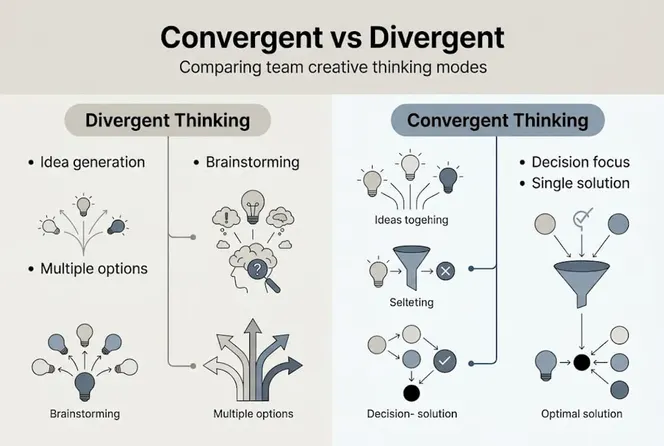
| Dimension | Divergent thinking | Convergent thinking |
|---|---|---|
| Purpose | Generate many ideas | Select the best idea |
| Process | Open, exploratory, associative | Logical, evaluative, structured |
| Mindset | “Yes, and…” | “Which one fits best?” |
| Outcome | Wide range of options | Single actionable decision |
| Best-use scenario | Innovation sprints, discovery sessions | Evaluation, prioritization, final decisions |
Knowing when to switch is just as important as knowing the difference. Here’s a simple sequence you can run in your next planning session:
- Identify the problem clearly. Make sure everyone understands what you’re solving before you open the floor.
- Set a divergent window. Give the team 15 to 20 minutes to generate ideas without interruption or evaluation.
- Pause and reset. Signal explicitly that you’re shifting modes: “Now we’re going to evaluate.”
- Apply convergent criteria. Use a scoring matrix or simple voting to narrow down options.
- Decide and assign. Commit to one direction and allocate clear ownership.
This cycle mirrors the approach used in Double Diamond and design thinking frameworks, which deliberately alternate between divergent and convergent phases to produce innovative yet executable solutions.
Some leaders treat these styles as rivals. That’s a mistake. Evidence supports integration: full creativity requires both modes applied iteratively, not in competition.
Pro Tip: Before your next meeting, decide in advance which mode you need. Write it at the top of your agenda: “EXPLORE” or “DECIDE.” This one small change prevents teams from mixing both modes at the wrong time and going in circles.
How combining both boosts creativity and results
Here’s something that surprises most leaders: being skilled at one thinking mode actually supports the other.
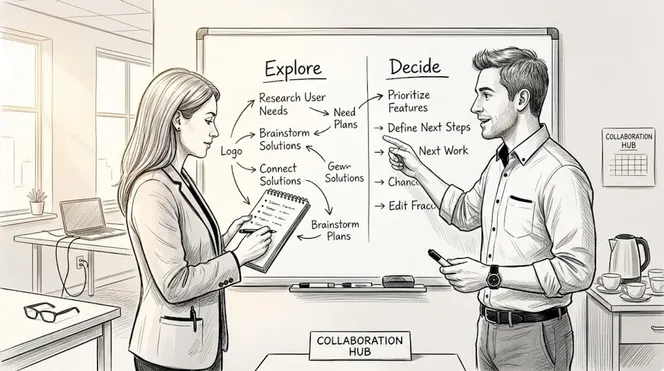
A positive correlation exists between divergent and convergent thinking. Individuals who are strong in one mode often excel in both. This means investing in your team’s creative skills doesn’t weaken their analytical judgment; it sharpens it.
Look at the measurable impact when teams deliberately combine both modes:
| Outcome area | Divergent only | Convergent only | Both combined |
|---|---|---|---|
| Innovation rate | High volume, low quality | Low volume, high risk-aversion | High volume, high quality |
| Decision speed | Slow, hard to finalize | Fast but narrow | Balanced and confident |
| Team engagement | High initially, frustration later | Low creative buy-in | Sustained and motivated |
| Solution quality | Unfiltered, inconsistent | Filtered too early | Refined and tested |
Frameworks like the Double Diamond and design thinking are built specifically around this pairing. They don’t just allow both modes; they require alternating between them at structured intervals. The result is a process that captures bold ideas while still delivering clear, executable outcomes.
One statistic worth noting: PISA 2022 creativity data found that roughly 1 in 4 responses to divergent tasks included at least two genuinely creative ideas, and training was shown to improve divergent thinking more significantly than convergent thinking. This tells us divergent capacity has more room to grow with the right support.
Here’s what teams consistently gain when they integrate both modes:
- Faster innovation cycles because ideas move quickly from generation to evaluation
- Stronger team alignment since everyone participates in both creating and deciding
- Higher solution quality because options are explored broadly before being filtered
- Reduced rework because decisions are grounded in both creativity and analysis
Common pitfalls and how to avoid them
Knowing the benefits isn’t enough. Leaders also need to recognize the traps.
The most common problem is staying in divergent mode too long. When teams keep generating ideas without ever committing to evaluation, they fall into analysis paralysis. Meetings run long, decisions get deferred, and frustration grows. Everyone has seen this happen.
The opposite trap is just as damaging. Moving to convergent thinking too early cuts off valuable ideas before they’re fully explored. This is how teams end up with safe, predictable solutions that don’t move the needle.
AI tools accelerate ideation in the divergent phase, generating options faster than any single human. But they can disrupt expert convergence if leaders rely on them to make evaluation decisions. The judgment call about which idea fits your team’s context, values, and resources is still a human skill.
Here are signs your team is stuck and how to fix them:
- Stuck in divergent mode: Meetings produce lists but no decisions. Fix: set a hard deadline for idea generation and move to scoring.
- Stuck in convergent mode: The team keeps refining the same two options without exploring alternatives. Fix: run a short brainstorm with no evaluation allowed.
- Mode confusion: Some people are brainstorming while others are evaluating simultaneously. Fix: use explicit signals to mark which mode is active.
- Skipping divergent entirely: Leaders jump straight to solutions. Fix: mandate a dedicated exploration phase before evaluation begins.
Pro Tip: Use a simple verbal cue at the start of each meeting segment. Say “We’re in explore mode” or “We’re in decide mode” out loud. It sounds basic, but it aligns the entire room instantly and prevents cross-mode friction.
Why the real skill is switching seamlessly
Most creativity training focuses on one mode. You either learn brainstorming techniques or decision-making frameworks. Rarely does anyone teach you how to switch between them, and that’s the real competitive edge.
The deliberate switching between modes is what separates innovative teams from average ones. It’s not about having the best brainstormers or the sharpest analysts. It’s about knowing, as a team, when to open up and when to lock in.
We’ve seen leaders who are exceptional divergent thinkers get consistently outperformed by teams that switch well. Why? Because raw creative output without structured evaluation rarely reaches execution. And fast decision-making without enough exploration leads to projects that fix the wrong problem entirely.
The most effective switch signals are simple and specific. Phrases like “Let’s explore for ten minutes, then we decide” work better than vague facilitation. They give people permission to fully commit to one mode without hedging.
AI tools can assist with both phases, but they cannot feel the room. They won’t know when your team has reached creative saturation or when a particular idea deserves more exploration before being scored. That contextual judgment is irreplaceable. Build the habit in your team deliberately, and it becomes one of your most durable operational advantages.
Take the next step: Power up your team’s creative process
Mastering the balance between convergent and divergent thinking is one of the most practical improvements you can make to how your team works together.
But structure and signals only go so far without the right system behind them. Gammatica helps business leaders and project managers build workflows that support both creative exploration and focused execution. Whether you’re running innovation sprints or managing delivery timelines, the platform keeps your team aligned and your processes clear. If you’re a founder building a high-performing team, explore Gammatica for founders. If you’re scaling a sales or project team, see what Gammatica sales can do for your operation.
Frequently asked questions
What is the main difference between convergent and divergent thinking?
Convergent thinking narrows options to a single solution using logic, while divergent thinking freely explores many creative possibilities without immediate judgment. One closes down, the other opens up.
Can one person be strong in both convergent and divergent thinking?
Yes. Empirical data shows a positive correlation between the two; individuals strong in one tend to perform well in both, and targeted training can develop both skills further.
How do you know which thinking style to use in your team?
Use divergent thinking during idea generation and discovery, and convergent thinking when refining or selecting. Double Diamond and design thinking frameworks formalize this alternation into repeatable cycles.
What are signs of over-reliance on one thinking style?
Endless brainstorming with no decisions signals too much divergence, while rushed choices with few alternatives explored shows excessive convergence. Over-reliance on either mode creates predictable and costly failure patterns in teams.