Teams practicing deliberate nurturing behaviors achieve productivity gains of up to 30% compared to traditionally managed groups. Nurturing in project management means actively cultivating collaboration, trust, and psychological safety through intentional leadership actions. This guide explores what nurturing looks like in business contexts, why it transforms project outcomes, and how you can implement evidence-based nurturing strategies to unlock measurable improvements in team performance and morale.
Key takeaways
| Point | Details |
|---|---|
| Nurturing defined | Deliberate cultivation of trust, collaboration, and psychological safety through active listening, personalized feedback, and recognition. |
| Performance impact | Teams experience 15-30% productivity gains, reduced conflicts by 40%, and significantly lower burnout rates. |
| Common myths | Nurturing does not slow decisions or equal micromanagement; it accelerates outcomes by building autonomy and trust. |
| Framework pillars | Emotional support, knowledge sharing, and environment optimization guide systematic nurturing practices. |
| Technology enabler | AI automation saves 16+ hours weekly, freeing managers to focus on team development and support activities. |
Understanding nurturing in project management
Nurturing within project management refers to the deliberate cultivation of collaboration, trust, and open communication among team members. It involves specific behaviors that foster psychological safety and support individual growth.
Practical nurturing behaviors include:
- Active listening during team discussions and one-on-one meetings
- Providing personalized, constructive feedback tailored to individual learning styles
- Recognizing contributions publicly and acknowledging effort alongside results
- Creating space for team members to experiment and learn from mistakes
- Facilitating knowledge sharing and peer mentoring opportunities
These actions build trust and openness, improving communication quality and project coordination. Nurturing differs from generic leadership by focusing on individualized support rather than broad directives. It also contrasts sharply with micromanagement, which controls tasks closely instead of empowering autonomy. Effective nurturing creates conditions where team members feel valued, heard, and motivated to contribute their best work.

Why nurturing matters: psychological and performance benefits
Nurturing creates psychological safety, the foundation for high-performing teams. When team members feel safe to voice concerns, share ideas, and take calculated risks without fear of ridicule or punishment, innovation flourishes.
Key psychological and performance benefits include:
- Enhanced communication as team members openly discuss challenges and opportunities
- Increased creativity through willingness to propose unconventional solutions
- Sustained engagement driven by feeling valued and supported
- Lower stress levels reducing burnout and turnover rates
- Improved problem-solving from diverse perspectives shared freely
Research demonstrates that nurturing improves team morale and reduces burnout by creating psychological safety. Higher morale translates directly into greater creativity and sustained effort on complex projects. Teams experiencing lower stress maintain focus and energy throughout project lifecycles, avoiding the productivity dips common in high-pressure environments.
“Psychological safety is the belief that you won’t be punished or humiliated for speaking up with ideas, questions, concerns, or mistakes. It’s essential for learning and innovation in teams.”
These combined effects increase overall project productivity and success rates, as teams collaborate more effectively and maintain momentum through challenges.
Common misconceptions about nurturing
Several myths prevent organizations from fully embracing nurturing practices. Understanding these misconceptions helps leaders implement effective strategies without hesitation.
Myth 1: Nurturing slows decision-making. Reality shows the opposite. Teams with strong psychological safety make faster decisions because members share information openly and commit quickly to agreed-upon directions. Debate happens earlier and more efficiently when people trust each other.
Myth 2: Nurturing is a “soft” skill without business impact. This misconception ignores substantial evidence linking nurturing to measurable productivity gains, reduced turnover costs, and faster project delivery. Financial outcomes improve when teams function effectively.
Myth 3: Nurturing equals micromanagement. This confusion causes leaders to avoid nurturing entirely. True nurturing supports autonomy and growth, while micromanagement restricts independence and erodes trust. Nurturing means checking in to offer support, not controlling every task detail.
Clarifying that autonomy-supportive nurturing increases buy-in helps organizations adopt these practices confidently. When managers understand they can nurture while respecting team member independence, resistance decreases.
Pro Tip: Train managers on emotional intelligence to nurture effectively. Skills like active listening, empathy, and recognizing emotional cues enable leaders to provide meaningful support without overstepping boundaries.
Frameworks of nurturing in teams
A structured framework organizes nurturing into three core pillars, making implementation systematic and sustainable.
| Pillar | Focus | Key activities |
|---|---|---|
| Emotional support | Building trust and psychological safety | Regular check-ins, empathetic listening, celebrating wins, acknowledging struggles |
| Knowledge sharing | Fostering continuous learning | Peer mentoring programs, documentation practices, cross-functional collaboration |
| Environment optimization | Creating productive conditions | Clear goals, appropriate resources, removing obstacles, flexible work arrangements |
Each pillar requires specific responsibilities from leaders and team members. Leaders model vulnerability, facilitate knowledge exchange, and ensure resource availability. Team members actively participate in mentoring, share insights openly, and provide constructive feedback to peers.
Integrating nurturing with daily project management processes:
- Begin daily standups with brief personal check-ins to gauge team energy and morale.
- Incorporate peer recognition into sprint retrospectives and project reviews.
- Schedule recurring one-on-one meetings focused on growth and support, not just status updates.
- Create dedicated channels for knowledge sharing and celebrating learning moments.
- Build buffer time into project plans to accommodate learning curves and experimentation.
- Use project milestones as opportunities to acknowledge effort and progress collectively.
This framework transforms nurturing from abstract concept to actionable routine, embedded naturally into existing workflows.
Measurable impact of nurturing on productivity
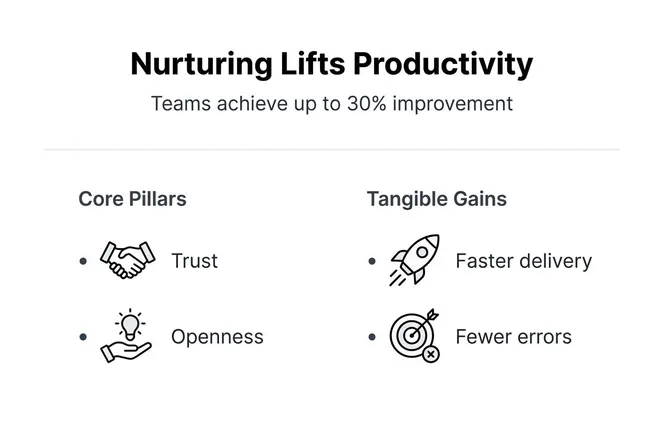
Quantitative data proves nurturing’s tangible value. Organizations using nurturing strategies see 15-30% productivity improvements measured through delivery velocity, output quality, and project completion rates.
| Metric | Impact | Context |
|---|---|---|
| Productivity gain | 15-30% increase | Measured across project delivery speed and output volume |
| Conflict reduction | Up to 40% decrease | Fewer interpersonal disputes requiring management intervention |
| Delivery velocity | 25% faster sprints | Software teams completing more story points per iteration |
| Employee retention | 20% lower turnover | Reduced costs and knowledge loss from departures |
Case examples illustrate these gains concretely. A software development team implementing structured nurturing practices increased their average sprint velocity by 25% over six months. They attributed improvements to better collaboration, reduced misunderstandings, and team members feeling comfortable asking for help early.
Qualitative benefits complement quantitative metrics. Improved morale shows up in engagement surveys, voluntary participation in learning activities, and positive peer feedback. Enhanced collaboration appears in smoother handoffs, proactive problem-solving, and knowledge sharing without prompting.
“The data is clear: teams that feel supported and psychologically safe consistently outperform those operating in fear-based or purely transactional environments.”
These combined impacts make nurturing one of the highest-return investments in project management effectiveness.
Implementing nurturing practices
Actionable steps help project managers embed nurturing into daily workflows without overwhelming existing responsibilities.
- Establish regular one-on-one meetings with each team member, focusing on growth, challenges, and support needs rather than purely status updates.
- Implement daily check-ins where team members share not just task progress but also blockers, learning moments, and energy levels.
- Create peer mentoring pairs or small groups for knowledge sharing and mutual support.
- Launch recognition programs that celebrate effort, learning, and collaboration alongside results.
- Build feedback routines that provide timely, specific, and constructive input tailored to individual preferences.
- Document and share lessons learned from both successes and failures to normalize continuous improvement.
Utilizing AI automation to reduce administrative tasks creates capacity for nurturing activities. When managers spend less time on status reporting, scheduling, and data entry, they gain hours for meaningful team interactions.
Key automation opportunities include:
- Automated task assignment based on workload and skills
- AI-generated meeting summaries and action items
- Intelligent calendar coordination for team availability
- Template-based workflows reducing repetitive setup
Pro Tip: Balance nurturing with clear decision deadlines. Psychological safety thrives when combined with accountability and structure. Set explicit timelines for decisions while encouraging open discussion within those boundaries.
Building rhythms that sustain team trust and efficiency requires consistency. Weekly patterns of check-ins, monthly learning sessions, and quarterly retrospectives create predictable opportunities for nurturing without requiring constant improvisation.
Technology and nurturing in modern project management
AI and automation tools relieve managers from routine work, dramatically increasing their capacity to nurture teams effectively. Modern platforms can save 16+ hours weekly by handling repetitive administrative tasks that traditionally consumed manager attention.
Freed time enables managers to focus on:
- Meaningful one-on-one conversations exploring career development and personal growth
- Observing team dynamics and intervening early when conflicts or misunderstandings arise
- Coaching individuals through challenging situations with personalized guidance
- Building relationships through informal interactions that strengthen trust
Examples of technology integrations supporting nurturing include:
- AI-powered sentiment analysis detecting team morale shifts from communication patterns
- Automated workflow orchestration reducing manual coordination overhead
- Intelligent scheduling tools finding optimal meeting times without back-and-forth emails
- Knowledge base platforms organizing and surfacing relevant information automatically
- Integration hubs connecting multiple tools to eliminate redundant data entry
Technology enhances communication routines by providing real-time visibility into team workload, progress, and potential bottlenecks. Managers can proactively offer support when systems flag overloaded team members or stalled tasks. Knowledge sharing accelerates when platforms make expertise discoverable and documentation effortless.
The combination of human nurturing and technological efficiency creates optimal conditions for high-performing teams. Technology handles process execution while managers focus on the irreplaceable human elements of leadership.
Measuring nurturing outcomes
Assessing nurturing effectiveness requires tracking both qualitative and quantitative metrics. Data-driven measurement enables continuous improvement and demonstrates value to stakeholders.
Key metrics include:
- Employee engagement scores from regular pulse surveys measuring psychological safety, belonging, and satisfaction
- Turnover rates tracking retention of high performers and overall team stability
- Sentiment analysis from team communications revealing morale trends and potential issues
- Productivity KPIs like delivery velocity, cycle time, and quality metrics correlated with nurturing activities
- Participation rates in mentoring, learning programs, and voluntary collaboration initiatives
Tracking engagement and turnover provides clear indicators of team health. Declining engagement or increasing departures signal nurturing gaps requiring attention. Use sentiment analysis tools to gain qualitative insight from Slack messages, emails, and meeting transcripts, identifying themes and emotional patterns.
Link productivity KPIs directly to nurturing activities by tracking metrics before and after implementing specific practices. For example, measure sprint velocity for three months, introduce weekly one-on-ones, then measure for another three months to quantify impact.
Identify and address gaps with data-driven adjustments. If engagement surveys reveal low psychological safety scores, focus on trust-building activities. If turnover concentrates in specific teams, investigate management practices and provide targeted coaching. Regular measurement creates accountability and guides resource allocation toward highest-impact nurturing investments.
Explore nurturing-enhancing solutions with Gammatica
Gammatica’s AI-driven platform reduces administrative workload by automating task management, scheduling, and workflow coordination. This automation creates space for leaders to focus on team development and nurturing activities that drive productivity gains.
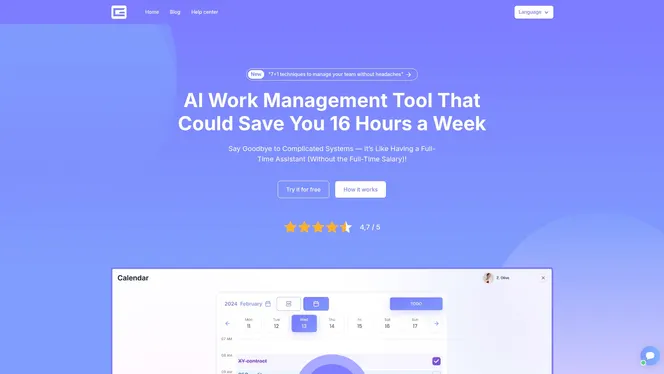
Founders gain visibility into team collaboration patterns through integrated dashboards and analytics. Gammatica for founders provides insights into workload distribution, project progress, and potential bottlenecks without requiring manual status updates. Gammatica AI automation handles repetitive workflows through intelligent orchestration, while the Gammatica Sales platform streamlines customer relationship management. Explore solutions that amplify team productivity by combining automation efficiency with human-centered leadership.
FAQ
What are some simple examples of nurturing in project management?
Active listening during meetings, providing personalized feedback tailored to individual needs, and recognizing contributions publicly exemplify nurturing behaviors. Regular one-on-one meetings focused on growth and peer mentoring programs also demonstrate nurturing in action.
How does nurturing impact team productivity quantitatively?
Nurtured teams show 15-30% productivity improvements in project delivery speed and output quality. These gains reflect better collaboration, reduced conflicts, and sustained engagement throughout project lifecycles.
What is the difference between nurturing and micromanagement?
Nurturing supports autonomy and trust by focusing on emotional support, growth opportunities, and empowerment. Micromanagement controls tasks closely, reducing team independence and eroding morale through excessive oversight and lack of trust.
How can technology enhance nurturing in project management?
Automation saves time on routine administrative tasks, enabling managers to focus on team support and development. Tools provide insights into team dynamics, streamline communication, and surface knowledge automatically, boosting nurturing capacity and effectiveness.