Most American teams still measure productivity with basic numbers, even though research shows that over 60 percent of managers misinterpret what drives actual performance. Relying only on hours worked or outputs misses the real story behind team success. Understanding the nuanced reality of team dynamics matters for any business aiming to see lasting results. This guide sheds light on smarter ways to evaluate teamwork so decision-makers avoid common mistakes and focus on what truly drives progress.
Table of Contents
- Defining Team Productivity Metrics And Misconceptions
- Types Of Team Productivity Metrics Explained
- How Metrics Drive Team Performance
- Real-World Use Cases For Business Leaders
- Risks And Common Pitfalls To Avoid
Defining Team Productivity Metrics and Misconceptions
Productivity measurement isn’t a simple numbers game. While many organizations track basic output metrics, truly understanding team performance requires a nuanced approach. The Input–Process–Output model provides a sophisticated framework for evaluating team effectiveness beyond traditional quantitative assessments.
Common misconceptions about team productivity often revolve around simplistic measurement techniques. Managers frequently make the mistake of equating hours worked with actual output, which fails to capture the complex dynamics of team performance. Performance metrics should instead consider multiple dimensions, including collaboration quality, individual skill contribution, and collective problem-solving capacity.
Understanding team productivity requires moving beyond surface-level measurements. The Harmony Index introduces an innovative approach by categorizing team members based on their unique impact on overall performance. This method recognizes that productivity isn’t uniform across team members and that individual contributions vary significantly.
Key considerations for accurate team productivity measurement include:
- Evaluating both qualitative and quantitative performance indicators
- Recognizing individual strengths within collective contexts
- Tracking collaborative effectiveness, not just individual output
- Considering skill diversity and interaction patterns
- Measuring adaptability and problem-solving capabilities
Successful teams understand that productivity metrics are tools for improvement, not punitive instruments. By adopting a holistic, nuanced approach to measurement, organizations can create environments that genuinely support team growth and performance.
Types of Team Productivity Metrics Explained
Understanding team productivity requires a comprehensive approach that goes beyond simple output measurement. Team productivity metrics can be strategically categorized into three primary dimensions: task metrics, process metrics, and individual development metrics.
Task metrics focus on the direct outputs and results generated by the team. These metrics quantify the tangible deliverables, such as completed projects, sales targets, or product development milestones. Quantitative performance indicators help organizations track concrete progress and assess the team’s ability to meet specific objectives.
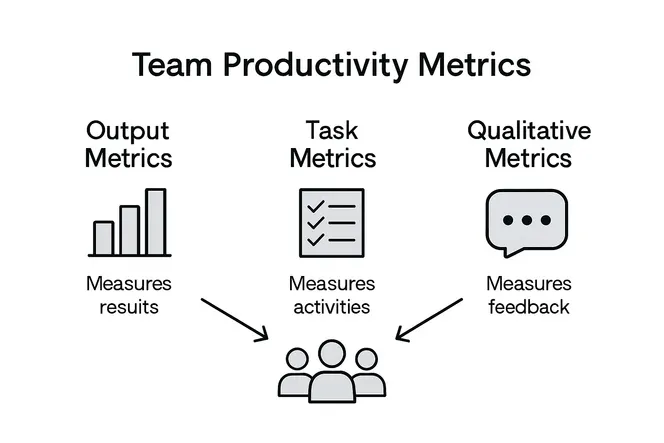
Steiner’s Taxonomy of Tasks provides a sophisticated framework for understanding task complexity and interdependence. This approach recognizes that not all team tasks are created equal, and productivity measurement must account for the inherent variations in task structures. Some tasks are divisible and can be easily distributed, while others require complex collaborative efforts.
Key types of team productivity metrics include:
-
Task Metrics
- Quantitative project completion rates
- Output volume and quality
- Deadlines met and project milestones achieved
-
Process Metrics
- Collaboration effectiveness
- Communication efficiency
- Workflow optimization
- Team coordination and synergy
-
Individual Development Metrics
- Skill progression
- Learning curve
- Individual contribution to team goals
- Adaptability and problem-solving capabilities
Effective team productivity measurement requires a holistic approach that balances quantitative results with qualitative insights. By understanding these diverse metric categories, organizations can create more nuanced and supportive performance evaluation systems that recognize the complex nature of team dynamics.
How Metrics Drive Team Performance
Team performance is a dynamic ecosystem where carefully selected metrics can transform organizational potential. Research exploring team size and productivity reveals that measurement isn’t just about tracking numbers, but understanding the intricate relationships between team structure, individual contributions, and collective output.

Performance metrics serve as crucial navigational tools, providing insights beyond surface-level observations. They help organizations identify strengths, address potential bottlenecks, and create targeted interventions that enhance team capabilities. By establishing clear, measurable indicators, leaders can create a feedback loop that continuously improves team dynamics and operational efficiency.
Innovative research on team structures demonstrates that flatter organizational models, when paired with strategic metrics, can significantly boost scientific innovation and productivity. This approach recognizes that traditional hierarchical measurements often fail to capture the nuanced ways teams actually generate value.
Key strategies for leveraging metrics to drive team performance include:
- Establishing transparent, achievable performance benchmarks
- Creating metrics that measure both individual and collective contributions
- Implementing real-time feedback mechanisms
- Developing adaptive measurement systems that evolve with team needs
- Focusing on qualitative indicators alongside quantitative data
Successful organizations understand that metrics are not punitive tools, but collaborative instruments for growth. By approaching performance measurement as a supportive process that celebrates progress and identifies opportunities, teams can unlock their true potential and drive meaningful organizational innovation.
Real-World Use Cases for Business Leaders
Business leaders across industries are discovering the transformative power of strategic team productivity metrics. Performance measurement is no longer a one-size-fits-all approach, but a nuanced strategy tailored to specific organizational goals and team dynamics.
In technology companies, metrics have become critical for managing complex software development teams. Project managers can track individual and collective contributions through granular measurements like code commit frequency, bug resolution rates, and collaborative problem-solving indicators. These metrics help identify high-performing team members, address potential bottlenecks, and create targeted professional development opportunities.
Marketing and sales teams provide another compelling example of metrics-driven performance optimization. By tracking key performance indicators such as lead conversion rates, customer engagement metrics, and collaborative win rates, organizations can create more responsive and adaptive team structures. Metrics enable leaders to understand not just individual performance, but the intricate ways team members complement and support each other’s strengths.
Practical applications of team productivity metrics include:
- Identifying skill gaps and training needs
- Optimizing team composition and collaboration
- Creating data-driven performance improvement plans
- Recognizing and rewarding exceptional team contributions
- Developing more responsive organizational structures
Successful implementation requires a holistic approach that balances quantitative measurements with qualitative insights. Business leaders who view metrics as collaborative tools for growth, rather than punitive instruments, can unlock unprecedented levels of team performance and organizational innovation.
Risks and Common Pitfalls to Avoid
Navigating team productivity metrics requires careful strategy and nuanced understanding. Research examining organizational environments highlights the complex interplay between measurement techniques and team psychological well-being, revealing that poorly implemented metrics can cause more harm than good.
Metric misalignment represents one of the most significant risks organizations face. When performance indicators are incorrectly designed, they can inadvertently incentivize counterproductive behaviors. Employees might focus on manipulating metrics rather than genuinely improving performance, creating a toxic environment that undermines collaborative potential and erodes team trust.
Psychological factors play a critical role in metric effectiveness. Overly rigid or punitive measurement systems can trigger stress, reduce motivation, and lead to decreased team morale. The most successful organizations understand that metrics should inspire and guide improvement, not create an atmosphere of constant surveillance and judgment.
Key risks and pitfalls to avoid include:
- Overemphasizing quantitative metrics at the expense of qualitative insights
- Creating metrics that encourage individual competition over team collaboration
- Implementing one-size-fits-all measurement approaches
- Failing to regularly review and adjust performance indicators
- Using metrics as purely punitive tools
- Neglecting the psychological impact of constant performance tracking
- Ignoring individual team member’s unique contributions and contexts
Effective metric implementation requires a holistic, empathetic approach that balances data-driven insights with human-centered leadership. Organizations must view productivity metrics as collaborative tools for growth, designed to support and elevate team potential rather than create unnecessary pressure or division.
Unlock True Team Potential With Smart Productivity Metrics and AI
Measuring team productivity is about more than just crunching numbers. The article highlights critical challenges such as the risk of metric misalignment, the importance of balancing qualitative and quantitative data, and the need to recognize individual strengths within collective teamwork. If your organization struggles with tracking meaningful performance insights or suffers from the pitfalls of oversimplified metrics, it is time to embrace a smarter, more holistic solution.

Gammatica.com offers an AI-driven team management platform designed to help business leaders like you overcome these exact hurdles. With features like task management, automation, and intelligent workflow coordination through Kanban boards and checklists, Gammatica streamlines collaboration and maximizes results across diverse teams. Benefit from AI suggestions that reduce administrative workload and save you up to 16 hours per week. Don’t let confusing or misaligned productivity metrics hold your team back. Discover how you can create transparent, adaptive performance benchmarks that support growth and innovation by visiting Gammatica. Get started now to transform your team’s productivity with data-driven clarity and powerful automation.
Frequently Asked Questions
What are team productivity metrics?
Team productivity metrics are measurements used to assess the performance and effectiveness of a team. They can include task metrics, process metrics, and individual development metrics, providing a comprehensive view of both quantitative and qualitative aspects of team dynamics.
How can I improve team productivity measurements?
To improve productivity measurements, consider using a balanced approach that evaluates both qualitative insights and quantitative data. Implement feedback mechanisms, adapt metrics to team needs, and establish clear performance benchmarks that reflect both individual and collective contributions.
Why is it important to go beyond basic output metrics?
Going beyond basic output metrics is essential because traditional measurements often fail to capture the complexities of team dynamics. A deeper understanding helps organizations identify strengths, address bottlenecks, and create an environment that fosters collaboration and innovation.
What are some common pitfalls in measuring team productivity?
Common pitfalls include overemphasizing quantitative metrics, incentivizing competition over collaboration, and neglecting the psychological impact of constant performance tracking. It’s crucial to design metrics that support growth and take into account the unique contributions of each team member.